On now
Coming soon
Reflections

The Watchtower

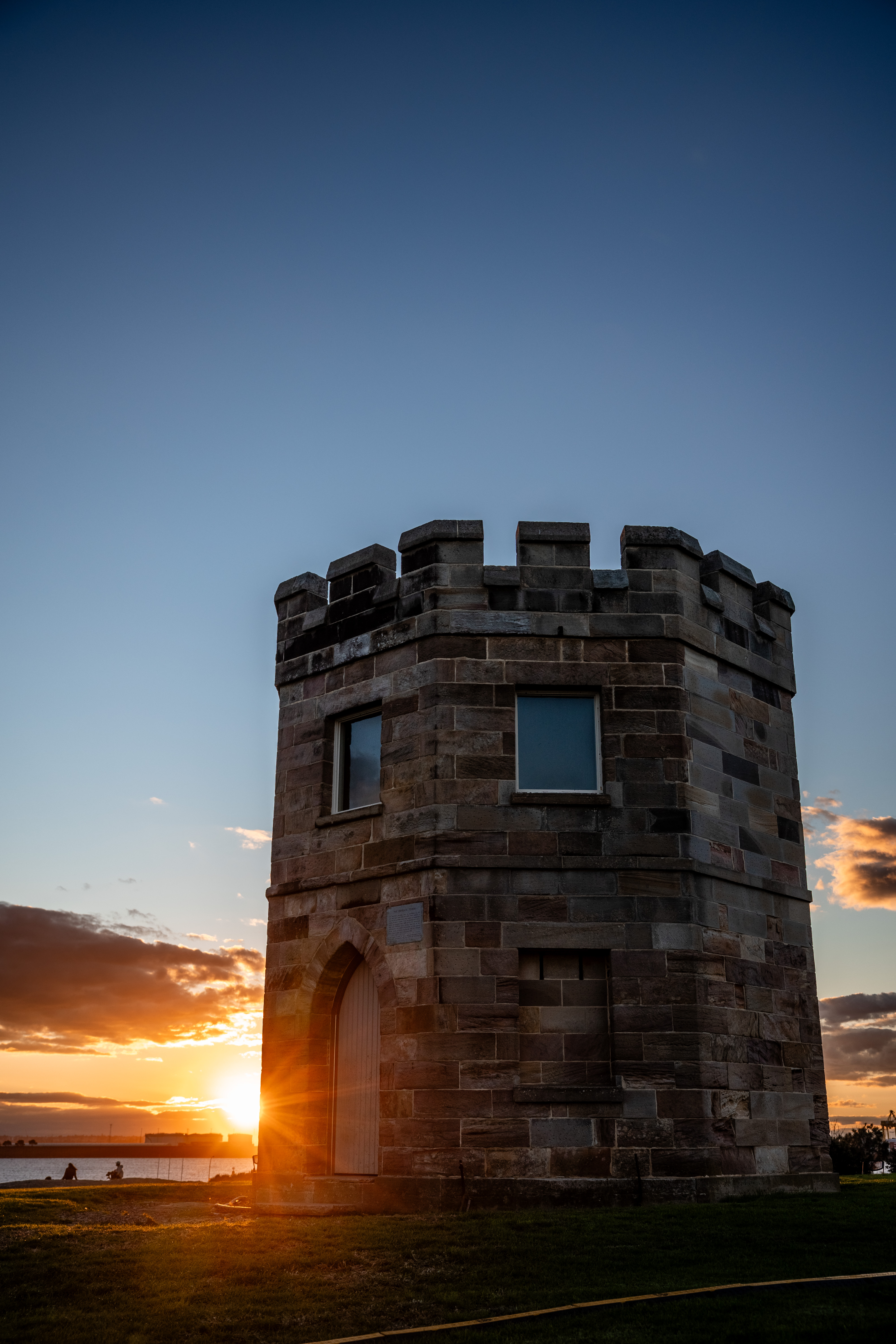
Located on the northern headland of Gamay / Botany Bay, the Macquarie Watchtower, also known as the Barrack Tower, is the oldest surviving sandstone tower in Australia. The structure dates from a time when the coastline was carefully watched and goods moving between the colonies were subject to customs duties. The complex issue of inter-colonial tariffs was one of the factors that encouraged the colonies to unite to form the Commonwealth of Australia in 1901.


Text by Yuan Liu, Museum Officer

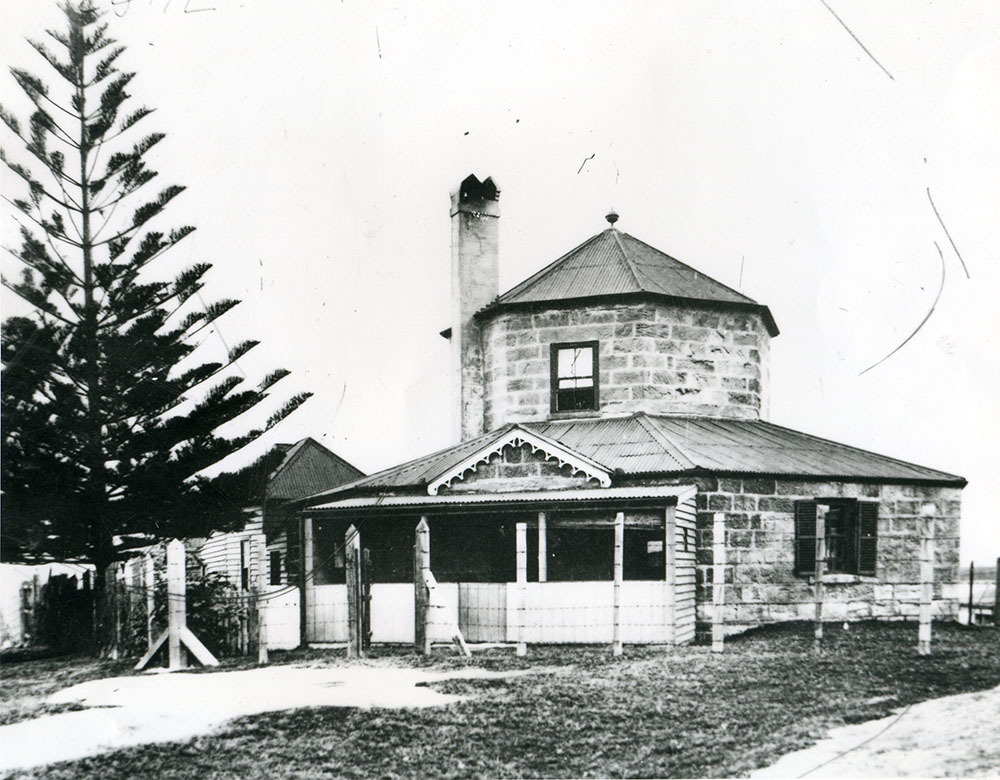
The original octagonal sandstone structure had two stories, with a castellated turret top, and remains a prominent feature of the La Perouse headland.


Facing south with its Gothic arch, the tower provides a vantage point overseeing both Cape Banks and Cape Solander, the northern and southern headlands of Botany Bay.  During the day, large container ships and oil tankers pass Bare Island en route to Port Botany, creating quite a spectacle. This geographical advantage makes it an ideal location for coastal watch. For that reason, government troops were stationed here as early as the 1820s to monitor unauthorised vessels and smuggling, particularly those carrying spirits and tobacco.

Coastal watch pre-Federation

When was the Watchtower built, commissioned by whom, and for what purpose?


The short answer is, we don’t know for sure. It is generally dated to the early 1820s and often associated with Colonial Governor Lachlan Macquarie (in office 1810-1821), despite a lack of evidence linking it to his public works program.


The earliest reference of the tower appeared in the Syndey Gazette on 20 March 1822, who published a sonnet celebrating the erection of a tablet at Inscription Point in Kurnell, commemorating Captain James Cook. The poet imagines what Cook and Banks would have seen when they were present; “here on this South Head / Should stand an English farm hut; and there / On yon North shore, a barrack tow’r should peer”. The line may suggest that a tower had already existed on the northern headland of Botany Bay by 1822.


A more direct description came from the French navy officer Hyacinthe de Bougainville, who visited Botany Bay in 1825 during his 1824-1826 circumnavigation. In his published journal he described: “three hundred paces away to the North one can glimpse through the trees a Gothic turret serving as a guardhouse for the small detachment tasked with watching over the bay. This tower seemed to have been erected expressly to watch over our future monument.”


This ‘future monument’ referred to a memorial to comte de La Pérouse, for which Bougainville would lay the foundation stone later that year. The expedition’s artist Touanne created the earliest visual representation of the tower in the background of a drawing that featured the La Perouse Monument.


The original purpose of the tower is also ambiguous. According to a letter dated December 1829 from Charles Wilson, Director of Public Works, the ‘octagon tower’ was erected ‘in lieu of huts for soldiers stationed there”. A corporal and several men were stationed there to “report vessels entering the harbour and to prevent smuggling”.


However, earlier that year when the Department of Public Works proposed to repair the tower, Governor Darling questioned, “for what purpose was this Tower originally intended?” The inquiry was referred to J. T. Campbell, Secretary to Governor Macquarie, Darling’s predecessor. Unaware of the tower’s existence, Campbell suggested two possibilities: it was either constructed as a military guard house or a monument in honour of Captain Cook and his crew. This record suggests that the Watchtower was unlikely to have been constructed or commissioned during Macquarie’s administration, given his secretary did not know of it.


In a much earlier account, convict artist Joseph Lycett noted a ‘small dwelling’, marking the spot of the French garden, that was used as “a look-out station, where two privates and a corporal are kept on duty, to give information of the arrival of any ship, which bad weather may drive into the bay, or which may enter by mistake instead of Sydney Harbour”. Historians of the Royal Australian Historical Society interpreted this as referring to the Watchtower. However, without a detailed physical description, is unclear whether this ‘small dwelling’ was indeed the tower in question.


The prevailing view today is that the Watchtower functioned as a coastal lookout and anti-smuggling post. It served as a work/living space. The upper-level bedroom was accessed by means of a ladder that could be drawn up at night, a precaution in a place known for its remoteness and isolation.


With the withdrawal of the military detachment around 1826, the Watchtower fell into dilapidation.  In 1829, the Department of Public Works called for the repair for it to function as the accommodation for a caretaker employed to look after the recently erected La Perouse Monument.
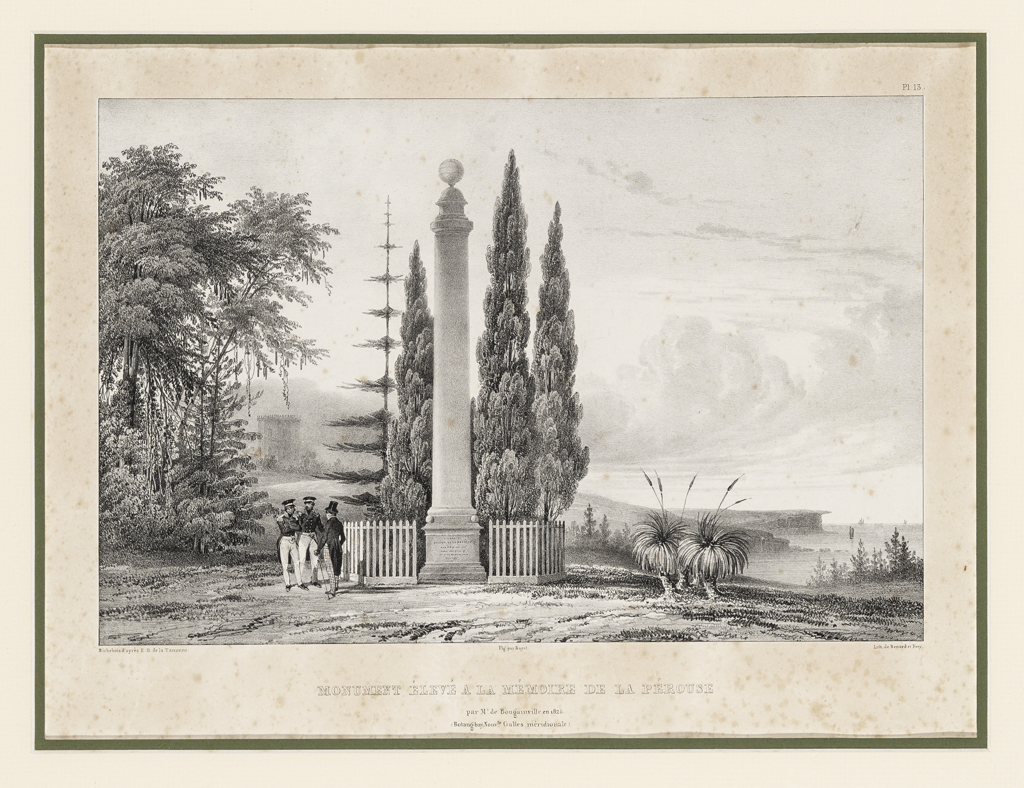
Lithograph, Monument Eleve a la memoire de La Perouse by Edmond Bigot de La Touanne, c.1826
Customs station (1831-1904)

Since the 1820s, a number of customs house outstations were established around the colony and the stone tower in La Perouse was acquired for that purpose. A tidewaiter and two boatmen were stationed onsite, and the tower continued to operate as a customs station until the early 20th century.


Repairs of the tower were undertaken periodically around the 1830s, although little documentations remain. In December 1835, a storm destroyed the windows and kitchen – a common weather condition at the headland - and by 1837 the structure was reportedly uninhabitable. Sometime between 1830 and 1850, a skillion extension was added to house a kitchen. The skillion was a cabbage tree slab construction built with the timber from cabbage tree palm, a common building material found in coastal Australia. It featured a low shingle roof which by 1863 occupied three sides of the octagonal tower.


The addition, with its lower, sloping roofs, connected the central stone core and can be seen in various photos taken before the 1950s; a striking contrast to its original austere look.


Additional repairs followed in the 1850s and '60s. By 1864, Colonial Architect James Barnet – later responsible for the 1822 Cable Station (now the La Perouse Museum) – was involved in improving the addition. By the end of 1864, a new stone walled skillion was near complete, but unfortunately a severe storm in the following year caused structural and water damage to the building, necessitating further repairs. The foundation of the octagonal stone skillion is still visible today.

Macquarie Watchtower c.1910s, Museums of History NSW

Botany Heads Provisional School

Following the Public Schools Act 1866, a group of people submitted an application to establish a school in Botany in July 1868.


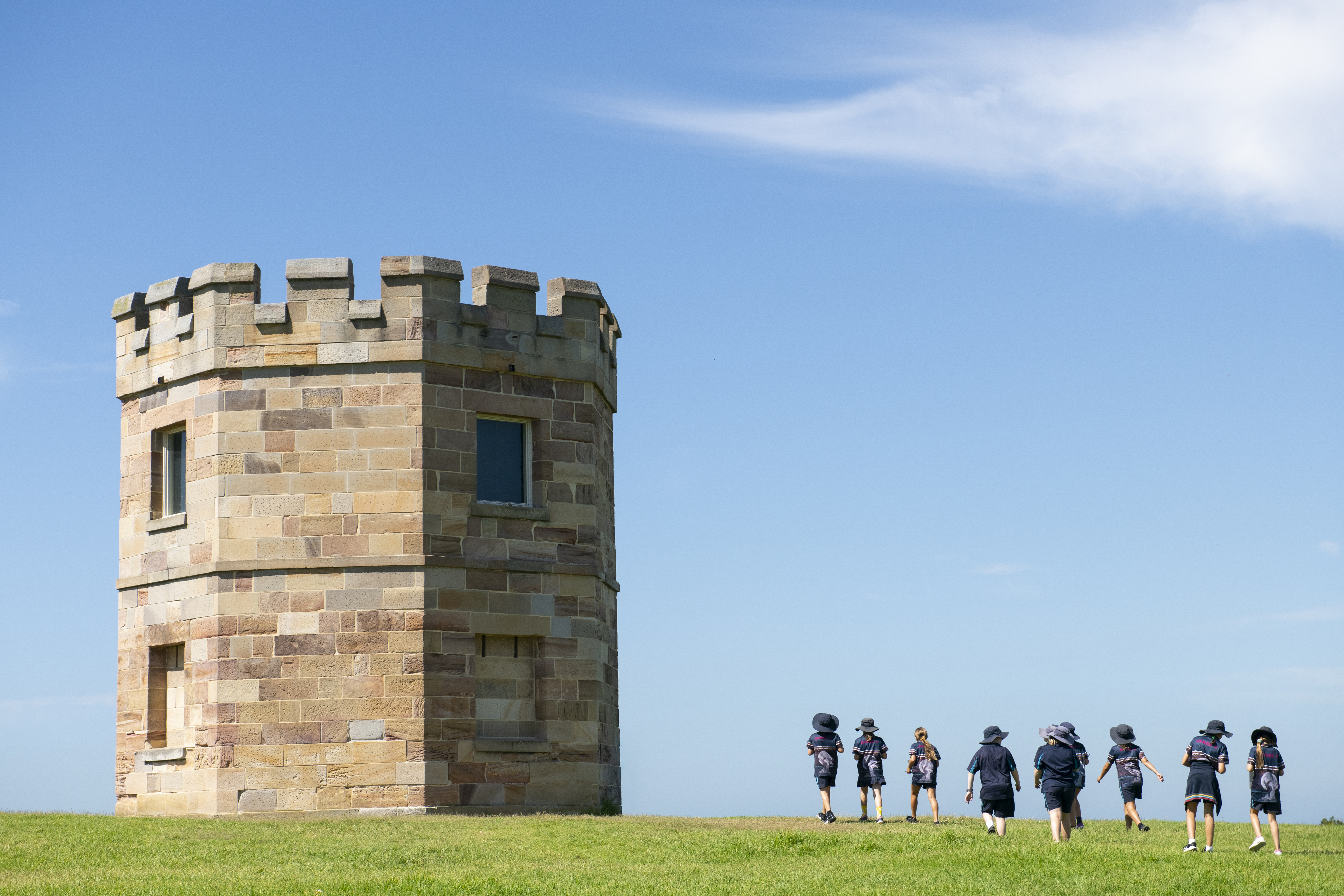
Among the main movers was then customs officer Michael McDermott, who offered a large room in the tower, his family’s living room, as the classroom. Thus began the Botany Heads Provision School, later known as the La Perouse Public School. The governess of McDermott’s children, Delia O’Brien became the school’s first teacher. The pupils consisted mainly of children of local gardeners, fishermen and customs employees.


In 1873, the school moved from the customs office to an adjoining structure erected by McDermott. Around that time, the customs building was increasingly referred to as Delaperouse, foreshadowing the future name of the locality. The school formally closed in 1890 and reopened two years later as the La Perouse Public School and eventually moved to its current Yarra Road site.


A thin brochure titled A century of integrated schooling: a brief historical account of La Perouse School from its foundation in 1868 to 1940 provides a comprehensive account of the school history, from charming anecdotes such as textbooks being delivered to the old Sir Joseph Banks Hotel,and more troubling realities such as the issues of hygiene, teaching standards and unfair treatment of Aboriginal students.


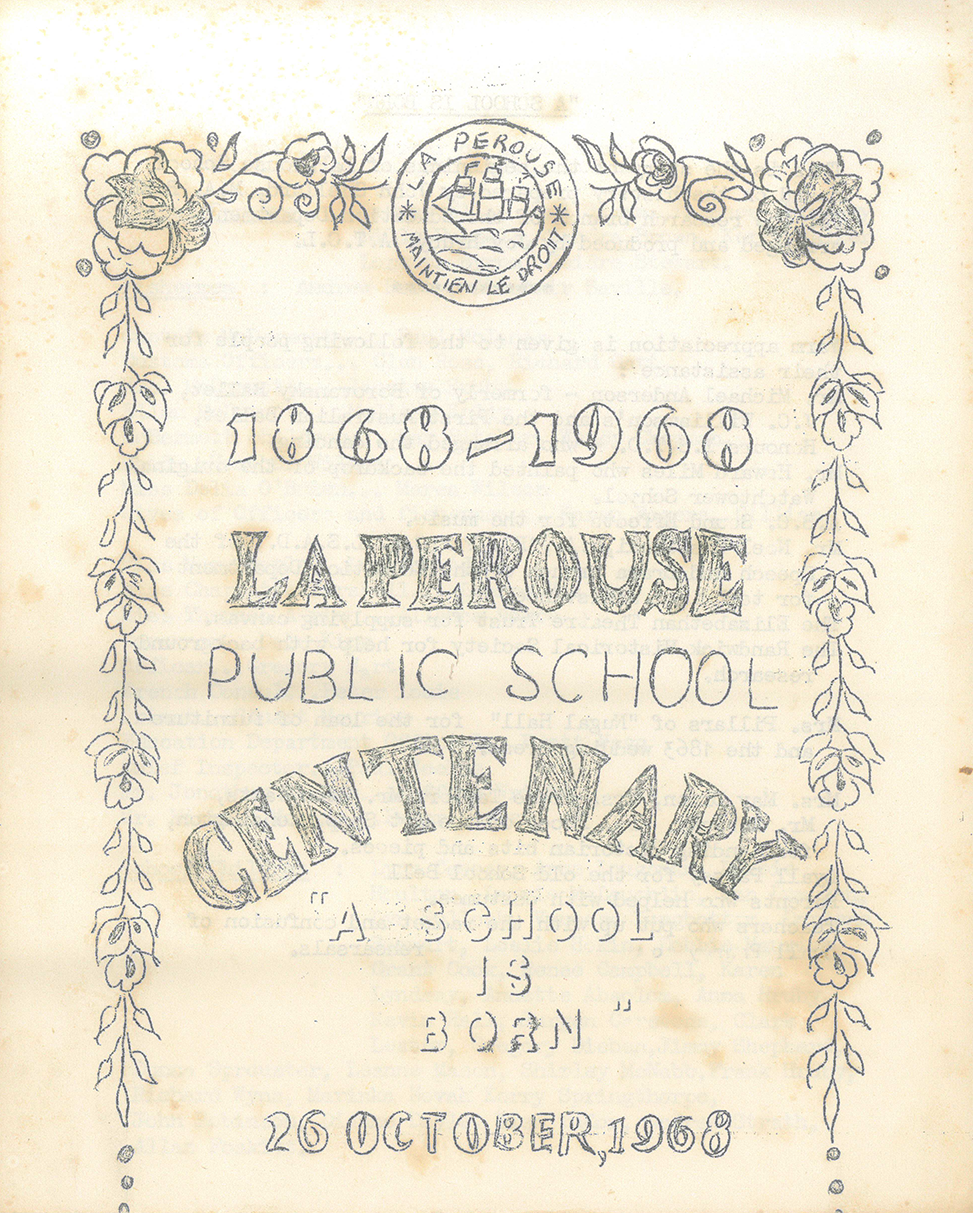
In 1968, Joy Hruby developed the play, "A School Is Born", based on historical records loaned to her by the Education Department. Promotional materials for the production celebrated the school as the first State school to enrol Aboriginal children, and one newspaper advertisement claimed that descendants of King Billy and Queen Timbery were pupils at La Perouse and would be performing in the play. 

Promotional material for the play "A School Is Born".

The end

From the 1880s, the focus of the headland shifted towards defence works on Bare Island and the establishment of the Cable Station. Staff numbers declined and the customs station became run down. When the Commonwealth was established in 1901, customs services became a federal responsibility, and the Watchtower was among many assets transferred from the NSW colony to the Commonwealth Government. The tower officially ceased to function as a customs station in 1903 and was passed to the Commonwealth Department of Internal Affairs in 1904.  It then became the retirement home of the last customs officer Peter Clark. The closure of the La Perouse customs outstation marked the end of inter-colonial tariffs.


The building remained in the Commonwealth’s hand untill the 1950s when the tower was placed under the care of the La Perouse Monuments Trust who appointed a resident caretaker. On 1 October 1957 a fire broke out in the tower causing the death of Mary Donnelly, wife of the caretaker. It was believed that the fire was started by a kerosene lamp exploding and fanned by a 50mph winds.


In the aftermath, the Trust removed most of the tower’s fabrics, leaving only the centre stone structure. The Lands Department commenced re-construction work in 1961, attempting to return it as closely as possible to its 1820s form. With the windows being sealed up to prevent vandalism, the Watchtower concluded its practical life as a workspace and living quarter, turning into a monument. In 1967, the site was acquired by the National Parks and Wildlife Service.


From a military lookout to a customs station, a public school and a caretaker’s home, the Watchtower remains a quiet witness to the colonial past, changing coastline and the enduring connection between people, land and sea.

Sources

Dan Tuck (2008) Botany Bay National Park NSW: a shared history, Vol. 1 of La Perouse Headland, NSW Dept. of Environment and Climate Change, Parks and Wildlife Division


Edith E. Grainger (6 June 1953) “Snares for Smugglers” in The Sydney Morning Herald 6 June 1953: 9


James Jervis, A.S.T.C. (1945) “The Stone Tower at La Perouse” in Royal Australian Historical Society Journal and proceedings Vol. 31, p.281-283


John W. Earnshaw (1947) “Further Notes on the La Perouse Tower” in Royal Australian Historical Society Journal and proceedings Vol. 33, p.110-115


Joseph Lycett Views in Australia or New South Wales and Van Diemen's Land, London: John Souter, 1824-1825


Journal de la navigation autour du globe de la frégate la Thétis et de la corvette l'Espérance, pendant les années 1824, 1825 et 1826, Vol. I. Paris: Arthus Bertrand, Libraire-Editeur, 1837


La Perouse Public School (1968) A brief historical account of La Perouse School from its foundation in 1868 to 1940


NSW Department of Environment and Climate Change & Jill Sheppard Heritage Consultants (2007) La Perouse Headland: Botany Bay National Park: conservation management plan


NSW Department of Public Works, Architectural Division (1987) The Cable Station La Perouse Conservation Plan May 1987, prepared for the NSW National Parks and Wildlife Service

La Perouse
  • naggangbi

    Hello/Greetings.
  • guriwaldha

    We are here at La Perouse.
  • ngalamanjang nhay

    This country belongs
  • gamaygalgulli

    to the Aboriginal people
  • nguranung

    of Botany Bay.