On now
Coming soon
Reflections

Monuments at the headland: Père Receveur’s tomb

The 1882 Cable Station building that now houses the La Perouse Museum is flanked by two other early nineteenth-century structures – the La Perouse Monument to the west and a Roman Catholic priest’s tomb to the east. The humble tomb features a painted stone structure surrounded by double rectilinear wall enclosures, and a brass cross bearing the Franciscan coat of arms, marking the burial place of Père Receveur, who visited Gamay / Botany Bay with La Perouse’s expedition in 1788.


Text by Yuan Liu, Museum Officer

The arrival

On 24 January 1788, French navigator Jean-François de Galaup, comte de La Pérouse arrived at Gamay / Botany Bay on the eastern coast of New Holland, which James Cook had visited and charted eighteen years earlier. This port of call was not in La Pérouse’s original itinerary: four months earlier, instructions from the King had reached him in Petropavlovsk on the Kamchatka Peninsula in Russia’s far east, asking him to stop at Botany Bay to ‘look over the new English settlement which should have been formed by the time [they] go to the eastern coast’.


It was the third year of La Pérouse’s circumnavigation – an undertaking sponsored by King Louis XVI to explore the Pacific regions of North and South America, Asia and Australasia. Before reaching Botany Bay, the French expedition had rounded Cape Horn, measured the megalithic statues on Rapa Nui / Easter Island, charted the northwest coast of America, anchored in Southeast Asia, crossed the water between Japan and Russia (Sōya Strait, also known as the La Pérouse Strait), and reached far eastern Russia in autumn. They were sailing back into the South Pacific.


In December 1787, the expedition reached Maouna in the Navigators Islands, now known as Tutuila in Samoa. On the eve of their planned departure, La Pérouse’s second-in-command, Paul Antoine Fleuriot de Langle, requested to replenish water supplies on the island due to concerns about scurvy. De Langle then led a watering party ashore, and among them was the ship’s chaplain, Père Receveur, who was himself suffering from the effects of scurvy. The party was received with stones and clubs near shore, which destroyed the ship’s longboats. In this violent encounter, de Langle and eleven crew members were killed. Receveur received a ‘violent contusion on the eye’ but managed to swim back to the barges and returned to the ship. This sorrowful event was recorded in La Pérouse’s journal and depicted in Plate 66 of the Atlas du voyage de La Pérouse.


For six weeks the French expedition camped at Botany Bay, where the First Fleet had recently arrived and was in the process of relocating to Port Jackson.


During this time, Receveur wrote to his brother, reassuring him that his wounds were ‘very trifling’ and ‘had healed within seven or eight days’. Over three years at sea, serving as chaplain as well as a naturalist and astronomer, he had never felt bored – so he wrote in the letter – but perhaps the capsize at Lituya Bay and the skirmish in Samoa reminded him of the dark side of maritime explorations. Now, he was looking forward to returning home, which he believed would not be long now.


The young priest died shortly afterwards. Whether from complications related to his injuries, the sequela of scurvy or other causes remains uncertain. He was buried on 17 February 1788 at the headland, more than 16,000 kilometres away from home.
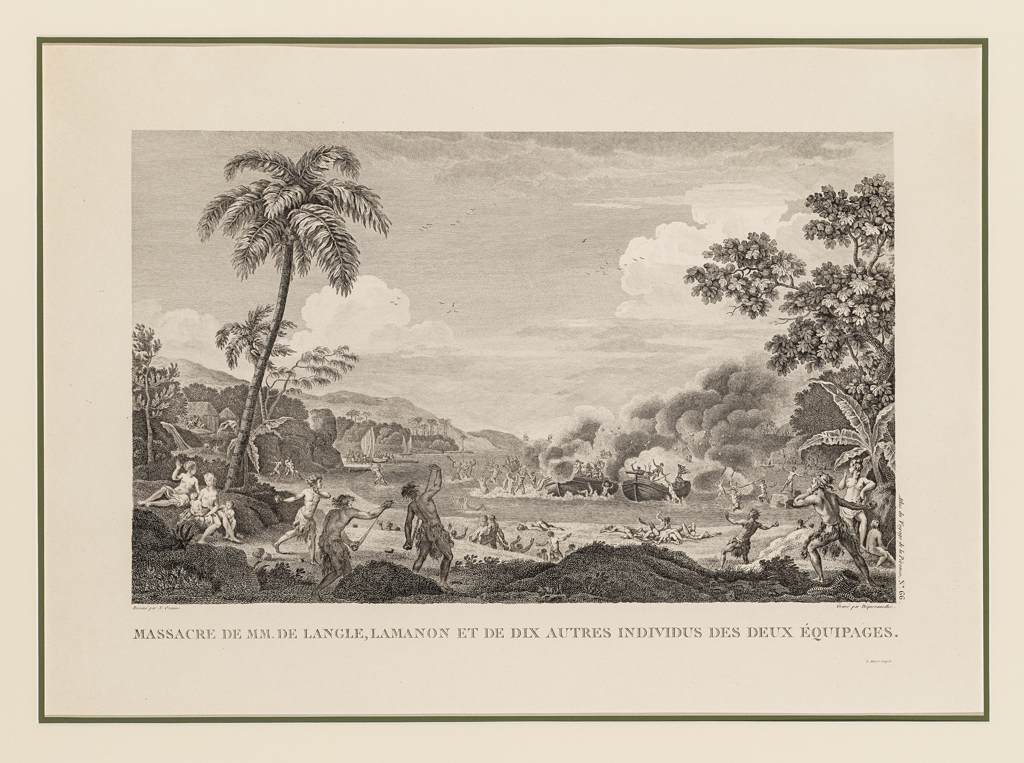
Engraving, Massacre de MM. de Langle, Lamanon et de dix autres individus des deux equipages (Massacre of de Langle, Lamanon and ten other individuals from the two crews), Pl. 66 of Atlas du voyage de Lapérouse, 1980s. La Perouse Museum / Object No. 88.27-15

Father Receveur

Claude-Francois Joseph Louis Receveur was born in April 1757 in the village of Noël-Cerneux in eastern France, near the Swiss border. After a period in the French navy, he entered the Franciscan Order, taking the religious name of Père (Father) Laurent in honour of the third-century Roman martyr, Saint Lawrence. In 1784, he took up residence at the Couvent des Cordeliers, the Order’s friary in Paris. It is likely that during this time he received education in not only theology, but astronomy, botany, geology, chemistry, meteorology, entomology and philosophy – training that prepared him for the upcoming adventure.


When La Pérouse was given command of L’Astrolabe and La Boussole for his circumnavigation, Receveur was selected by the Académie des Sciences to serve as naturalist and chaplain aboard L’Astrolabe, under its captain Fleuriot de Langle. He was one of two chaplains on this expedition, the other being Abbé Jean-André Mongez, who was also an astronomer. De Langle thus described Receveur in his report, providing a glimpse of what he was like at sea: ‘he is occupied in meteorological and astronomical observations, and when in port attends to everything relating to natural history’.

The grave

Receveur was buried on the headland that now bears the French navigator’s name. The original grave was marked by a headstone and a board nailed to a tree, bearing a Latin inscription,


Hic jacet L. Receveur E. F.F. Minoribus Galliae Sacerdos, Physicus in Circumnavigatione Mundi Duce D. De La Peyrouse. Obit die 17 Febr. Anno 1788

(Here lies Father Ex F.F. Minoris French Priest, physicist in the circumnavigation of the world of La Peyrouse, died 17 February 1788)


After La Pérouse’s departure from Botany Bay, the grave markers were lost or destroyed. Governor of NSW at the time, Arthur Phillip then engraved the original epitaph on a copper plate and installed it on a tree nearby, but this too disappeared at some point.


Back in France, the whereabouts of La Pérouse and his expedition remained a mystery until the 1820s. In the meantime, the site of the French encampment and Receveur’s tomb became a destination for French visitors to Sydney from the early nineteenth century.


The first recorded visit took place in March 1824, when the crew of the French ship La Coquille, under the command of Louis Isidore Duperrey, came ashore. Guided by the garrison stationed at the watchtower, they located the site of the French garden and Receveur’s grave, which at this point was no more than a grassy mound with no markings. On the trunk of an enormous eucalyptus tree shading the site, the officers from La Coquille carved a new inscription:


Prés cet arbre reposent les cendres du père Reçeveur, visité en Mars 1824

(Near this tree lie the remains of Father Receveur, visited in March 1824)


The permanent tomb of Receveur is directly associated with French navy officer Hyacinthe de Bougainville, who arrived at Botany Bay with Thetis and Esperance in 1825 during his circumnavigation. He noticed that Receveur’s burial site was marked by ‘some stones, surmounted by a cross roughly outlined’, along with the inscriptions on the tree trunk carved by the crew of La Coquille the year before. Without hesitation, he proposed to Governor Thomas Brisbane that permanent memorials be erected for both La Pérouse and Père Receveur.


On 6 September, Bougainville laid the foundation stone of the La Perouse Monument and left funds for construction. Both the monument and the tomb were completed in the subsequent years, to designs attributed to colonial architect George Cookney.


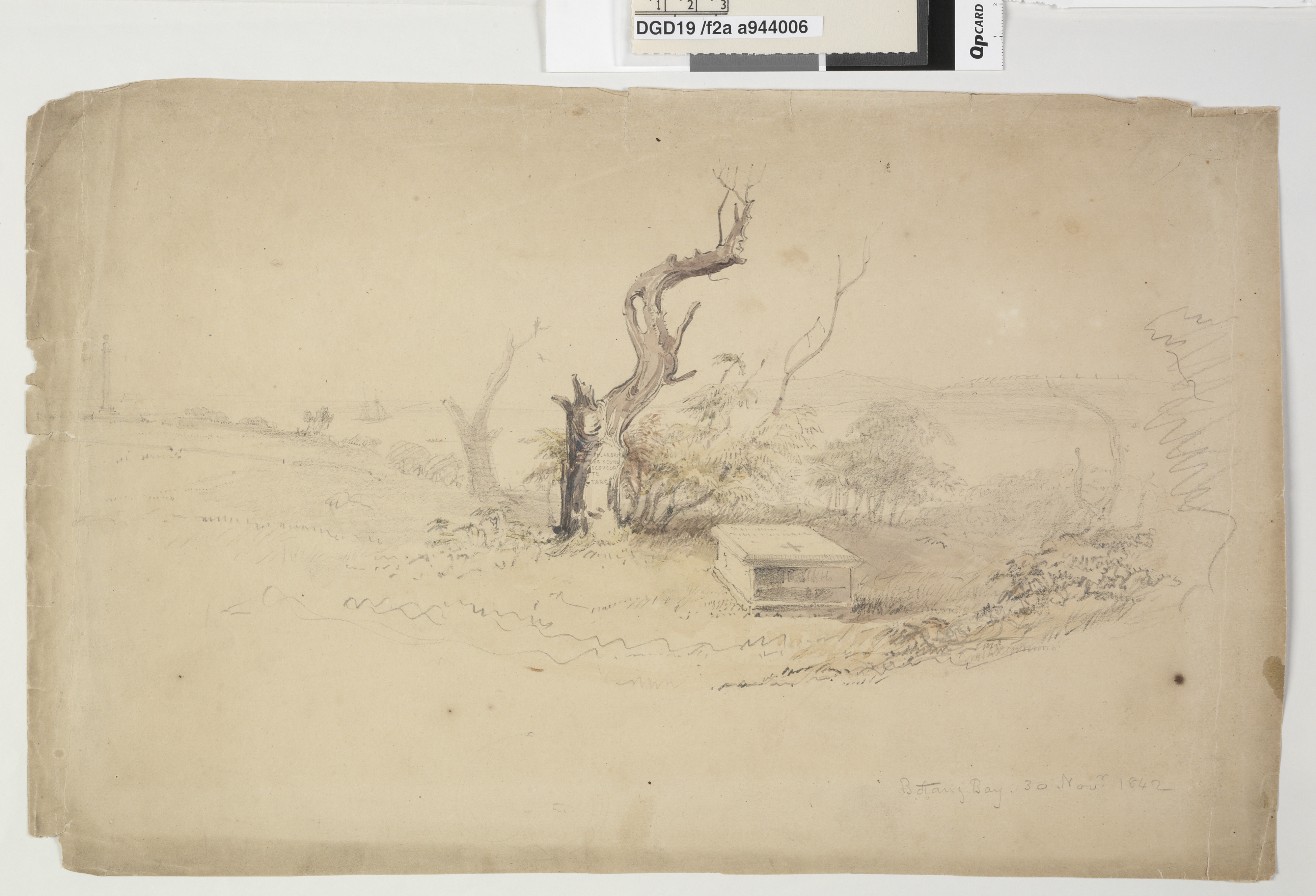
These newly established structures were featured in a sketch by Sir Oswald Brierly dated 1842, which shows the tomb in a form close to what we see today, seated next to the inscribed eucalyptus tree. The obelisk in honour of La Pérouse is visible in the background, surmounted by an orb resembling a spherical astrolabe, likely an homage to one of La Pérouse’s frigates, L’Astrolabe.


From the late nineteenth to early twentieth century, the tomb underwent repairs, including the replacement of the heavily eroded iron crucifix with a French-style bronze cross now in place.

Oswald W.B. Brierly, Botany Bay 30 Novr 1842, from Sketches mainly of Twofold Bay and the voyage of the H.M.S. Rattlesnake in New Guinea and the Louisiade Archipelago, c.1842-1854, Mitchell Library, State Library of New South Wales

The tree stump

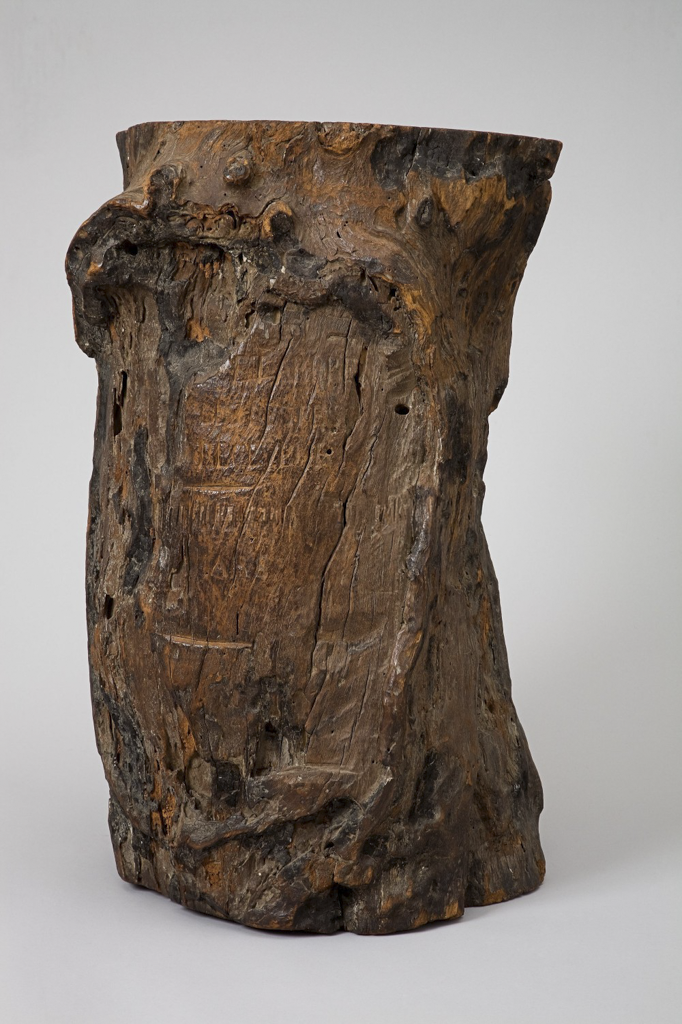
The eucalyptus tree that once marked the grave was eventually cut down, yet the inscribed tree trunk was preserved through the efforts of an early settler in the area named Simeon Pearce, later the first mayor of Randwick.


In the lead-up to the Paris Exposition Universelle of 1855, the tree stump was removed and displayed at the Exhibition of the Natural and Industrial Products of NSW – a preliminary event for the Paris exhibition – in Sydney’s Australian Museum, before being sent to the exhibition in Paris.


The decision seems inconceivable from a contemporary point of view, but this was a time when biosecurity concerns over transporting wood specimen cross borders and ethical concerns in exhibiting funerary objects in museums were less of a priority. In any case, the stump was displayed in the Sydney exhibition, along with a watercolour painting by Sydney artist Frederick Terry, depicting both French monuments at the La Perouse headland.


After being displayed at Exposition Universelle, the stump entered the collection of the Louvre and then the Musée de la Marine. In 1988, it was loaned to the newly formed La Perouse Museum in Australia for its opening exhibition, coinciding with Australia’s bicentennial celebration. It was returned to Paris in 2008 and has remained there since.


The eucalyptus stump saga did not end there. In 2012, the Friends of the Lapérouse Museum – a volunteer-based community organisation heavily involved in the founding of the Museum – commissioned Fonderie de Bronze Lauragaise to cast a bronze replica, sponsored by the Randwick City Council. The sculpture was shipped to Australia the following year by the French Embassy and subsequently unveiled at the Museum and blessed by the priest of St Andrew’s Catholic Parish Malabar.

Tronc d'arbre portant l'épitaphe du Père Receveur, 1788 © Musée national de la Marine / A. Fux

The altar stone

Another artefact associated with Receveur is a marble altar stone discovered at the wreck of La Boussole during the Association Salomon expedition of April 1981. Measuring 35cm by 35 cm, this consecrated marble slab was carried on La Pérouse’s voyage as a portable altar for the celebration of daily Mass, whether at sea or on land. We can also reasonably believe that it was used at the funeral Mass for Père Receveur on 17 February 1788.


Uncovered in three pieces, the original altar stone was presented to the NSW Minister for the Environment, Bob Carr in 1987 and was among a series of 18th-century artefacts selected for the inaugural exhibition at the La Perouse Museum in 1988. Like the original eucalyptus tree stump, the altar stone was sent to Musée de la Marine Paris in 2008 and remained there, while a replica was created in France using powdered stone and natural earth pigments. The reproduced altar stone was blessed by Franciscan priest Paul Ghanem at the La Perouse Museum on Sunday 18 November 2012.

The pilgramage

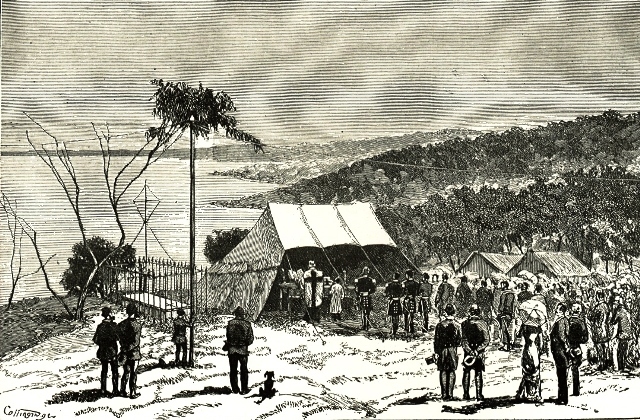
Receveur’s tomb has long been a site of private prayer, pilgrimage and commemoration. In 1993, as many as 5,000 people reported joined a pilgrimage to the site.


Now, annual Masses in Latin and French take place at the tomb to commemorate Père Receveur. The site is a reminder of the area’s association with La Pérouse’s expedition and the Roman Catholic Church in Australia.


Back to 7 February 1788, Receveur wrote to his brother from Botany Bay with much optimism. As one of the English boats were leaving for Europe soon, he said, ‘I chance this letter, uncertain if you will receive it before my arrival … Our return to France will take place in the spring of 1789 and perhaps even earlier… You have no idea of the eagerness I have to see my dear fatherland again, and to have news of my parents and friends… Goodbye, my dear brother, love me as I love you.’* He died ten days later.


*Transcriptions by Abbe Prosper-Fulgence Verdot, curate of Vesoul, Haute-Saone, translated by Edward Duyker

Officers and men of the French Warship Rhin attending Mass near the grave of Père Receveur in September 1879, image credit Prince Henry Community.

Sources

Duyker, Edward. Père Receveur: Franciscan, Scientist, and Voyager with Lapérouse. Dharawal Publications, 2011.


“Father Receveur’s Grave” The Sydney Morning Herald, 1 May 1933, 10.


Friends of the Laperouse Museum. Annual Report, 2013.


King, Robert J. “What Brought Lapérouse to Botany Bay?” Journal of the Royal Australian Historical Society 85, no. 2 (1999): 140–147.


Lapérouse and the Loss of the Astrolabe and the Boussole (1788): Reports of the 1986 and 1990 Investigations of the Shipwrecks at Vanikoro, Solomon Islands. Fremantle: Australian National Centre of Excellence for Maritime Archaeology, 2004.


“La Perouse Artefacts Find a New Home” The Canberra Times, November 16, 1987, 12.


Selkirk, H. “La Pérouse and the French Monuments at Botany Bay” Journal of the Royal Australian Historical Society Vol iv, pt. vii (1918): 329–361.

La Perouse
  • naggangbi

    Hello/Greetings.
  • guriwaldha

    We are here at La Perouse.
  • ngalamanjang nhay

    This country belongs
  • gamaygalgulli

    to the Aboriginal people
  • nguranung

    of Botany Bay.